Animal Welfare Conversations
Join us as we talk to people working towards a common goal - to improve animal welfare. We’ll chat to veterinary surgeons, veterinary nurses, animal owners, conservationists and others who have an important part to play in care and decision making about the lives of pets, domestic, farm or zoo animals and wildlife. We’re not afraid to challenge assumptions and question current beliefs. To keep up to date join our mailing list at https://www.animalwelfareconversation.com/
Listen on:


Episodes

Monday Dec 15, 2025
Monday Dec 15, 2025
This week, we had the privilege of speaking with Professor Eddie Clutton and Dr Polly Taylor, both distinguished anaesthetists and two of the co-editors of Veterinary Controversies and Ethical Dilemmas. Their book, now highly regarded within the veterinary profession, raises important questions about the current veterinary landscape, approaches to treatment, and standards of animal care. Our discussion covered a range of complex topics, including moral dilemmas, euthanasia, and over-treatment, offering diverse perspectives and highlighting unresolved issues within the profession.
The conversation explored the financial, emotional, and societal costs associated with animal treatment, prompting reflection on what outcomes we truly seek for our animals.
We hope you find this discussion on animal welfare both thought-provoking and informative.
Biographies
Dr PM Taylor MA VetMB PhD DipECVAA FRCVSEuropean & RCVS Veterinary Specialist in Anaesthesia
Polly graduated from Cambridge many years ago and worked in general practice then clinical academia in Cambridge University and the Animal Health Trust. Since 2002 she has been an independent consultant in veterinary anaesthesia, covering clinical anaesthesia, teaching, drug registration and research; numerous papers on anaesthesia and analgesia have resulted. Polly is a director of Topcat Metrology Ltd, developing bespoke nociceptive threshold testing systems for several animal species. She was a member of the Advisory Council for the Misuse of Drugs (2002-2010) and has continued to be an advocate for the veterinary profession regarding drug legislation. Her most recent activity putting her head above the parapet is to encourage the profession to understand that overtreatment of animals “just because we can” is often not in their best interests.
Prof Eddie Clutton BVSc (Hons) DVA DipECVAA FRCVSEuropean & RCVS Veterinary Specialist in Anaesthesia
Eddie Clutton graduated from the University of Liverpool in 1981 and completed postgraduate training in anaesthesia at the Department of Anaesthesia, The Royal Liverpool Hospital. After serving as Assistant Professor in Veterinary Anaesthesiology at the University of Virginia–Maryland, USA, he obtained the RCVS Diploma in Veterinary Anaesthesia in 1985. From 1990 to 2015, he led Veterinary Anaesthesia at the Royal (Dick) School of Veterinary Studies, University of Edinburgh, and was appointed Chair of Veterinary Anaesthesiology in 2007.
He is a Diplomate of the European College of Veterinary Anaesthesia and has held leadership roles including Editor-in-Chief of Veterinary Anaesthesia and Analgesia and President of the Association of Veterinary Anaesthetists. His professional memberships include the Royal College of Anaesthetists, the Association of Veterinary Anaesthetists, the Animal Welfare Science, Ethics and Law Association, the Laboratory Animal Veterinary Association, the Laboratory Animal Science Association and the Association of Veterinary Ethical Committees.
Eddie’s research focuses on pain management, anaesthesia monitoring in pigs and sheep, and medical ethics. He co-founded EthicsFirst in 2016 and the Research Animal Anaesthesia Network (RAAN) in 2025. He currently serves as Clinical Director of the Wellcome Trust Critical Care Laboratory for Large Animals at the Roslin Institute.
His contributions have been recognised with the Morpheus Award (2019) for exceptional contributions to Veterinary anaesthesia, analgesia and intensive care, RCVS Fellowship (2019) meritorious contribution to knowledge, and the Dalrymple-Champneys Cup and Medal (2024), the British Veterinary Association's Advancement of Veterinary Science Award, for the distinctive contributions he has made to the field of veterinary anaesthesia.. He was senior author of the FELASA guidelines for anaesthesia in biomedical research involving large animals.
Further Information
Veterinary Controversies and Ethical Dilemmas: Provocative Reflections

Sunday Dec 07, 2025
Sunday Dec 07, 2025
This week we catch up with Dr Jos Bongers, a veterinary neurologist from Glasgow Vet School, and Professor Sameer Zuberi, a paediatric neurologist at the Royal Hospital for Children in Glasgow. They discuss their career paths, the similarities and differences between human and veterinary neurology, and the impact of epilepsy on welfare of both animals and children.
We consider a variety of different topics including seizure classification and video diagnostics, similarities between human and veterinary neurology, welfare and quality of life, treatment of epilepsy and clinical trials, one medicine, and future breakthroughs in the treatment of epilepsy.
The discussion underscores the value of cross-disciplinary collaboration, technological innovation (especially video and AI), and a holistic approach to welfare in both human and veterinary contexts. Jos and Sameer hope for faster, more accurate diagnoses and treatments, particularly in resource-limited settings, and highlight the shared motivation to improve lives across species.
Biographies
Professor Sameer Zuberi MB ChB (Ed), MD, FRCP(Ed), FRCPCH
Professor Sameer Zuberi is a Consultant Paediatric Neurologist at the Royal Hospital for Children, Glasgow and Honorary Professor in the School of Health & Wellbeing at the University of Glasgow, leading the Paediatric Neurosciences Research Group. He studied at the University of Edinburgh and undertook postgraduate paediatric and neurology training in Edinburgh, Glasgow and Sydney. He is Clinical Lead of the Scottish National Genetic Epilepsy Service, Trustee of Health Innovation Scotland and Neurodevelopment Theme Lead of the Epilepsy Research Institute UK. He is immediate Past President of the European Paediatric Neurology Society, vice President of the European Brain Council (advocating for better brain health globally) and President-Elect of the British Paediatric Neurology Association.
He has been active in the International League Against Epilepsy, serving on many Task Forces, and was Chair of the Commission on Classification & Terminology 2013-17. His research group have a broad focus in childhood epilepsies including genetics, epidemiology, outcomes, trials & precision therapies and global health. In recent years he has developed and researched innovative technologies including smartphone video and AI for diagnosis & management, and devices to prevent sudden unexpected death in epilepsy. He has published more than 150 academic papers and many book chapters.
Sameer’s family includes a cat and a cocker spaniel. He is excited about collaborating with veterinary neurologists and owners in a project to improve classification of seizures in dogs using smartphone video.
Dr Jos Bongers MSc MVM DipECVN MRCVS
Jos is a veterinary neurologist with a primary focus on developing and expanding the Glasgow Seizure Clinic to improve diagnosis and treatment for pets with epilepsy and to strengthen support networks for their carers. She has also recently begun a PhD that examines the use of home video recordings for determining seizure semiology in dogs, guided by methods used in human medicine. She intends for this project to promote closer links between human and veterinary neurology and to deepen understanding of epilepsy across species. More information on the Seizure Clinic can be found via: https://petseizureclinic.co.uk/.
Other information
One Medicine and Humanimal Trust Home - Humanimal Trust

Wednesday Oct 01, 2025
Wednesday Oct 01, 2025
Decision making mini-series - episode 3 - Bias
In this episode we discuss the complexities of decision-making in veterinary medicine, focusing on biases that can impact clinical reasoning and client communication. We look at how biases can lead to misdiagnosis, affect treatment choices, influence client trust and ultimately impact on animal welfare.
We consider some of the more common biases, such as confirmation bias, anchoring bias, and availability bias, and emphasizes the importance of recognizing and mitigating these biases to improve diagnostic accuracy and patient safety.
As usual, we have more resources on this topic at Vet Your Decisions
In a future episode we're going to look at our favourite text books on animal welfare and decision making. I'm currently reading Veterinary Controversies and Ethical Dilemmas | Provocative Reflection (there are so many topics in here!) and it would be great if you could suggest your favourite books in this area.
A couple of the authors in this text book Tanya Stephens and Sean Wensley very kindly supported the The Animal Welfare Conversation podcast in the early days. If you've not listened to them yet then you can catch up here.
We hope you will join The Animal Welfare Conversation:
Sign up to the podcast mailing list Animal Welfare Conversations
Sign up to Vet Your Decisions mailing list Vet Your Decisions: Essential Vet Advice for Pet Owners (scroll to the bottom of the home page).
Y6BjMEfdwGKs9qYbuqVm

Monday Sep 22, 2025
Monday Sep 22, 2025
In the second episode focussing on Clinical Decision Making, this week we look at clinical reasoning. Last week we discussed the way in which vets make decisions and all of the things that they are juggling at the one time, considering their own knowledge and experience, alongside the needs of the owner and the needs of the animal.
Clinical reasoning encompasses all of the processes that take place in a consultation, and that lead to the decision making process. It can be described in different ways, but one approach is to consider: collecting information, processing it, identifying problems, setting goals, taking action, evaluating outcomes, and reflecting.
Alongside this we need to consider the importance of owner input, thorough patient history, and avoiding bias, alongside the need for clear communication with owners about treatment plans and costs.
More information can be found at Vet Your Decisions

Monday Sep 15, 2025
Monday Sep 15, 2025
In this episode of the Animal Welfare Conversation podcast, we take a break from the interviews, and will spend the next few weeks looking at the complexities of decision-making in veterinary medicine and how this relates to animal welfare.
In this first episode we look at the ways in which vets make decisions, and the mental gymnastics that go on when making clinical decisions. We look at the ways in which vets consider their own knowledge and experience, the owner wishes, and the needs of the animal.
Find out more about clinical decision making at:
Vet Your Decisions: Essential Vet Advice for Pet Owners
Vet Your Decisions Blog
Speaker Biography
Mary Fraser is the founder and host of The Animal Welfare Conversation podcast and Vet Your Decisions.
Dr Mary Fraser is a veterinary surgeon who has bridged the gap between human and veterinary medicine. She began her career in mixed practice, completed a PhD in canine dermatology funded by The Guide Dogs for the Blind Association and then moved into education and clinical research in both further / higher education and the corporate sector.
Along the way she has set up her own small animal veterinary practice, developed new training pathways for veterinary nurses, worked with Stirling University’s Innovation Centre and is now Executive Director of Education at the Royal College of Physicians of Edinburgh.
She is an Honorary Clinical Associate Professor at Glasgow University, and in 2017 she was awarded Fellowship of the Royal College of Veterinary Surgeons (FRCVS) for Meritorious Contributions to the Profession.
Her main interests, alongside One Medicine, are animal welfare, veterinary and medical education, clinical decision making and charitable work through Humanimal Trust and UHI Perth.

Monday Sep 08, 2025
Monday Sep 08, 2025
Welcome to the next episode of The Animal Welfare Conversation.
This week we meet Dr Rowena Packer, of the RVC.
Rowena is the Senior Lecturer in Companion Animal Behaviour and Welfare Science at the Royal Veterinary College, London, where she leads a research group exploring diverse topics in this area, including the impact of chronic and inherited disorders on dog behaviour and welfare, the impact of owner knowledge, attitudes and behaviour on canine welfare, and caregiver burden.
In this episode we delve into the controversial world of dog breeding, where human preferences for "cute" features often override concerns about animal health – particularly in brachycephalic breeds like pugs and French Bulldogs.
The podcast reveals how human biases in pet ownership directly impact animal welfare, challenging listeners to rethink their motivations behind breeding choices.
The discussion on brachycephalic breeds uncovers the often-overlooked health implications of emotional attachment in pet ownership, urging a shift toward prioritizing animal well-being over aesthetic preferences.
Dr Rowena Packer, BSc (Hons) PhD PGCert(VetEd) FHEA
Rowena is the Senior Lecturer in Companion Animal Behaviour and Welfare Science at the Royal Veterinary College, London. Rowena leads a research group exploring diverse topics in this area, including the impact of chronic and inherited disorders on dog behaviour and welfare, the impact of owner knowledge, attitudes and behaviour on canine welfare, and caregiver burden.
She has received >£2 million of research funding from diverse sources, with ~£1 million held as Principal Investigator.
Rowena is a frequent flyer on the conference circuit and has presented her research internationally, including in the USA, Australia, Canda, and across much of Europe.
Rowena has co-authored >100 peer reviewed papers and book chapters and co-edited the textbook ‘Health and Welfare of Brachycephalic (Flat-faced) Companion Animals’ (2021). Rowena holds a PhD from the Royal Veterinary College (2013) which explored the impact of extreme conformation on canine health, and has continued to research and drive initiatives on this topic for 16 years.
Rowena is a founding member of Brachycephalic Working Group and the Legal Advisory Group on Extreme Conformation in Dogs.
Find out more about Rowena’s research at https://www.rvc.ac.uk/about/our-people/rowena-packer
NOMINATE YOUR ANIMAL WELFARE HERE NOW:
If you haven't already done so, please nominate your animal welfare hero for our new award HERE

Monday Sep 01, 2025
Monday Sep 01, 2025
Professor Andrew KnightBVMS BSc PhD PFHEA DipECAWBM DipACAW MANZCVS FRCVS
Welcome to the next episode of the Animal Welfare Conversation. And this week we caught up with Prof Andrew Knight, animal welfare advocate, researcher and campaigner. In this episode we about Andrew’s journey of campaigning for animal welfare. We hear about the impact of livestock farming on climate change, the future of vegan diets and how this relates to animal welfare. We also consider how the veterinary profession can play a pivotal role in advocating for systemic change beyond the clinic.
Andrew established and directed the Centre for Animal Welfare at the University of Winchester; is a Principal Fellow of Advance HE; EBVS European and RCVS Veterinary Specialist in Animal Welfare Science, Ethics and Law; American & New Zealand Veterinary Specialist in Animal Welfare and a Fellow of the Royal College of Veterinary Surgeons.
In 2019 Andrew was awarded the Society for Veterinary Medical Ethics Shomer Award and also received the Humane Society Veterinary Medical Association Humane Achievement Award
Andrew has published a wide range of academic papers and books on animal welfare including The Costs and Benefits of Animal Experiments and co-edited the Routledge Handbook of Animal Welfare.
Further Information
Sites
https://www.andrewknight.info
https://sustainablepetfood.info
https://humanelearning.info
https://animalexperiments.info
socials
https://www.linkedin.com/in/andrew-knight-409b7434/
https://www.facebook.com/profile.php?id=100046421604769
https://www.youtube.com/c/andrewknight
Key infographics
Knight A (2023) The relative benefits for environmental sustainability of vegan diets for dogs, cats and people. PLoS ONE 18(10): e0291791. https://doi.org/10.1371/journal.pone.0291791
Knight A, Bauer A, Brown H (2023) Vegan versus meat-based cat food: Guardian-reported health outcomes in 1,369 cats, after controlling for feline demographic factors. PLoS ONE 18(9): e0284132. https://doi.org/10.1371/journal.pone.0284132
Vegan dog health
Other Information:
http://aknight.info/articles/pet-food
And finally.........
Please follow us on social media, and if you haven’t yet nominated you Animal Welfare Hero, please take time to nominate them. Find out more here. Alex Fraser Medal for Animal Welfare | Girling & Fraser Ltd Closing date is 30th September.

Monday Aug 25, 2025
Monday Aug 25, 2025
What makes a good life? Part 2
In this episode of the Animal Welfare Conversation, we continue the conversation with Dr Dan O’Neill of the RVC. Dan is well known in the veterinary profession for his work with VetCompass and animal welfare. Dan is a Fellow of the Royal College of Veterinary Surgeons, and has received many awards in recent years from BSAVA, Kennel Club Charitable Trust, and was awarded the RCVS Impact Award in 2025.
In this 2 part podcast episode we examine an animal’s capacity for a good life and the opportunities they get to fulfil that. In this eye-opening episode, Dr. O'Neill challenges traditional veterinary approaches, arguing that good animal welfare extends far beyond the absence of disease. He presents a groundbreaking framework based on two key elements: an animal's capacity for a good life and their opportunity to fulfil that capacity. Through compelling examples, including the concerning rise of brachycephalic breeds in the UK we see how human choices can significantly impact animals' ability to live naturally and happily.
BIOGRAPHY
Dr Dan O’Neill , Associate Professor Companion Animal Epidemiology, RVCMVB BSc(hons) GPCert(SAP) GPCert(FelP) GPCert(Derm) GPCert(B&PS) PGCertVetEd FHEA MSc(VetEpi) PhD FRCVS
Following 22 years in general veterinary practice, Dan moved to academia to gain a PhD and now co-leads the RVC VetCompass™ Programme.
With over 170 papers, he also co-authored the books ‘Breed Predispositions to Disease in Dogs and Cats’ and ‘Health and Welfare of Brachycephalic (Flat-faced) Companion Animals’.
He is a founding member of the UK Brachycephalic Working Group, the UK Legal Advisory Group on Extreme Conformation in Dogs and the International Collaborative on Extreme Conformation in Dogs.
Dan was awarded a Fellowship of the Royal College of Veterinary Surgeons in 2018, the BSAVA Blaine Award for Advancement of Small Animal Science in 2019, the International Canine Health Award from the Kennel Club Charitable Trust in 2021, the UK All Party Parliamentary Group ‘Phillippa Robinson Dog Welfare Award’ in 2024 and the RCVS Impact Award in 2025. Dan is currently developing his Innate Health Concept as an application for the All-Party Parliamentary Group for Animal Welfare (APGAW) that aims to shift the UK dog demographic progressively away from extreme conformation over the coming decade.

Monday Aug 25, 2025
Monday Aug 25, 2025
What makes a good life? Part 1
In this episode of the Animal Welfare Conversation, we meet Dr Dan O’Neill of the RVC. Dan is well known in the veterinary profession for his work with VetCompass and animal welfare. Dan is a Fellow of the Royal College of Veterinary Surgeons, and has received many awards in recent years from BSAVA, Kennel Club Charitable Trust, and was awarded the RCVS Impact Award in 2025.
In this 2 part podcast episode we examine an animal’s capacity for a good life and the opportunities they get to fulfil that. In this eye-opening episode, Dr. O'Neill challenges traditional veterinary approaches, arguing that good animal welfare extends far beyond the absence of disease. He presents a groundbreaking framework based on two key elements: an animal's capacity for a good life and their opportunity to fulfil that capacity. Through compelling examples, including the concerning rise of brachycephalic breeds in the UK we see how human choices can significantly impact animals' ability to live naturally and happily.
BIOGRAPHY
Dr Dan O’Neill , Associate Professor Companion Animal Epidemiology, RVCMVB BSc(Hons) GPCert(SAP) GPCert(FelP) GPCert(Derm) GPCert(B&PS) PGCertVetEd FHEA MSc(VetEpi) PhD FRCVS
Following 22 years in general veterinary practice, Dan moved to academia to gain a PhD and now co-leads the RVC VetCompass™ Programme.
With over 170 papers, he also co-authored the books ‘Breed Predispositions to Disease in Dogs and Cats’ and ‘Health and Welfare of Brachycephalic (Flat-faced) Companion Animals’.
He is a founding member of the UK Brachycephalic Working Group, the UK Legal Advisory Group on Extreme Conformation in Dogs and the International Collaborative on Extreme Conformation in Dogs.
Dan was awarded a Fellowship of the Royal College of Veterinary Surgeons in 2018, the BSAVA Blaine Award for Advancement of Small Animal Science in 2019, the International Canine Health Award from the Kennel Club Charitable Trust in 2021, the UK All Party Parliamentary Group ‘Phillippa Robinson Dog Welfare Award’ in 2024 and the RCVS Impact Award in 2025. Dan is currently developing his Innate Health Concept as an application for the All-Party Parliamentary Group for Animal Welfare (APGAW) that aims to shift the UK dog demographic progressively away from extreme conformation over the coming decade.
Friday May 16, 2025
Friday May 16, 2025
Welcome back!
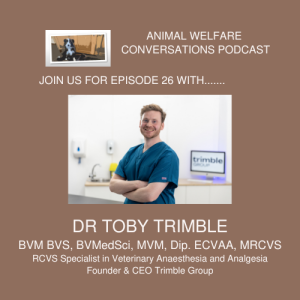
In this episode we catch up with Dr Toby Trimble, the founder of Trimble Group, a film production company, reinventing education for animal health. Listeners to the podcast will know that education features a lot in conversations about animal welfare, so, in this episode we get the chance to look at this in more detail and discover just why education is so important.
You can find out more about Toby's work at Trimble Group or find Toby on LinkedIn
Biography
Toby is an RCVS Specialist in Veterinary Anaesthesia and Analgesia and the founder of Trimble Group, a film production company reinventing education for animal health, making it less like PowerPoint and more like Netflix. He focuses on making education engaging, visual, and memorable. With his team, Toby has created over one thousand CPD videos and live broadcasts in the UK, Europe, Asia and Australia.